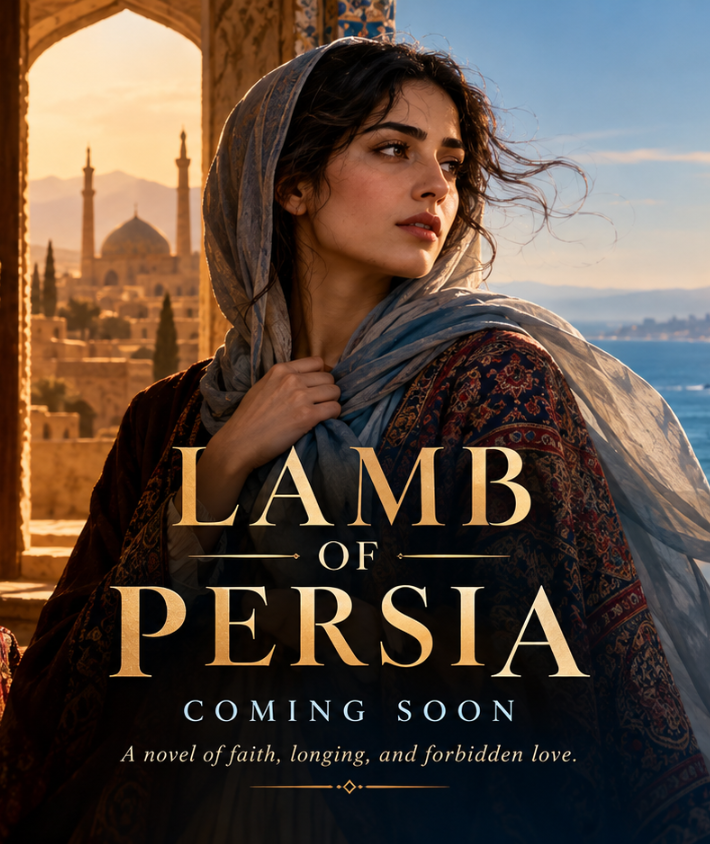
Lamb Of Persia
Some battles are fought within
Series
The Story Behind the Script
In the early 2000s, while taking a sociology class, I came across two photographs placed side by side at the bottom of a textbook chapter. On the left was a group of young women in bikinis riding in the back of a pickup truck in California. On the right stood four women covered from head to toe in black hijabs. The contrast was striking. Two groups of women, two very different cultures, and two seemingly opposite expressions of freedom, modesty, and identity. I found myself staring at those photographs, wondering what would happen if a woman from the picture on the right suddenly found herself living in the world of the picture on the left. What would she think? What would tempt her? What would frighten her? How would she reconcile everything she had been taught with the freedoms and possibilities suddenly surrounding her? And perhaps the most intriguing question of all: **Would she discover freedom, or simply encounter a different kind of captivity?** The more I considered the idea, the more I recognized something unexpectedly personal. Although I was an American man raised in a very different culture, I understood that struggle through my own Christian faith. Living as a Christian in modern America often means navigating a world filled with beautiful, exciting, and tempting possibilities while trying to remain faithful to convictions that aren't always easy to uphold. I realized that the struggle wasn't uniquely Iranian, Muslim, Christian, male, or female. It was profoundly human. From that realization, Yasmeen was born. I imagined a young Iranian woman leaving the familiar world of Tehran for Los Angeles, where everything seemed brighter, freer, and more inviting. Against the backdrop of California's beautiful coastline, bustling streets, and seemingly limitless possibilities, she would confront the desires, doubts, and competing voices that exist within all of us. I chose to tell her story first as a screenplay, using visual symbolism, contrasting characters, mirrors, and doorways to explore a battle that often takes place silently within the human heart. Years later, I decided to give Yasmeen's story another life, adapting the screenplay into a short novel that could bring readers closer to her thoughts, fears, desires, and difficult choices. *Lamb of Persia* began with two photographs in a sociology textbook. It became a story about something far greater than the differences between two cultures. **It became a story about the choices we make when the world offers us everything—and our conscience asks us what we're willing to sacrifice.**